On Solana, swapping connects many everyday trading actions: entering a token, exiting a position, moving back into SOL, preparing a wallet, reacting to market moves, or cleaning up after a trade. A weak swap flow can make those actions more expensive or harder to judge through worse routes, unclear fees, surprise slippage, failed transactions, or a wallet prompt the user cannot confidently approve.
Different swap platforms are built around different parts of that decision. A trader looking for broad routing needs a different surface from someone checking pool liquidity, simulating a transaction before signing, reducing execution risk, handling a large or thin-liquidity swap, or making a simple one-off trade. The useful question is which platform makes the next transaction clearer before assets move.
In this article, we take a deep dive into Jupiter Ultra, Raydium, Kamino, OKX, Titan, and Gemorik as Solana swap platforms. We compare them across the parts of a swap that matter in real use, then break down where each platform fits best.
1. Jupiter
Website: jup.ag/swap
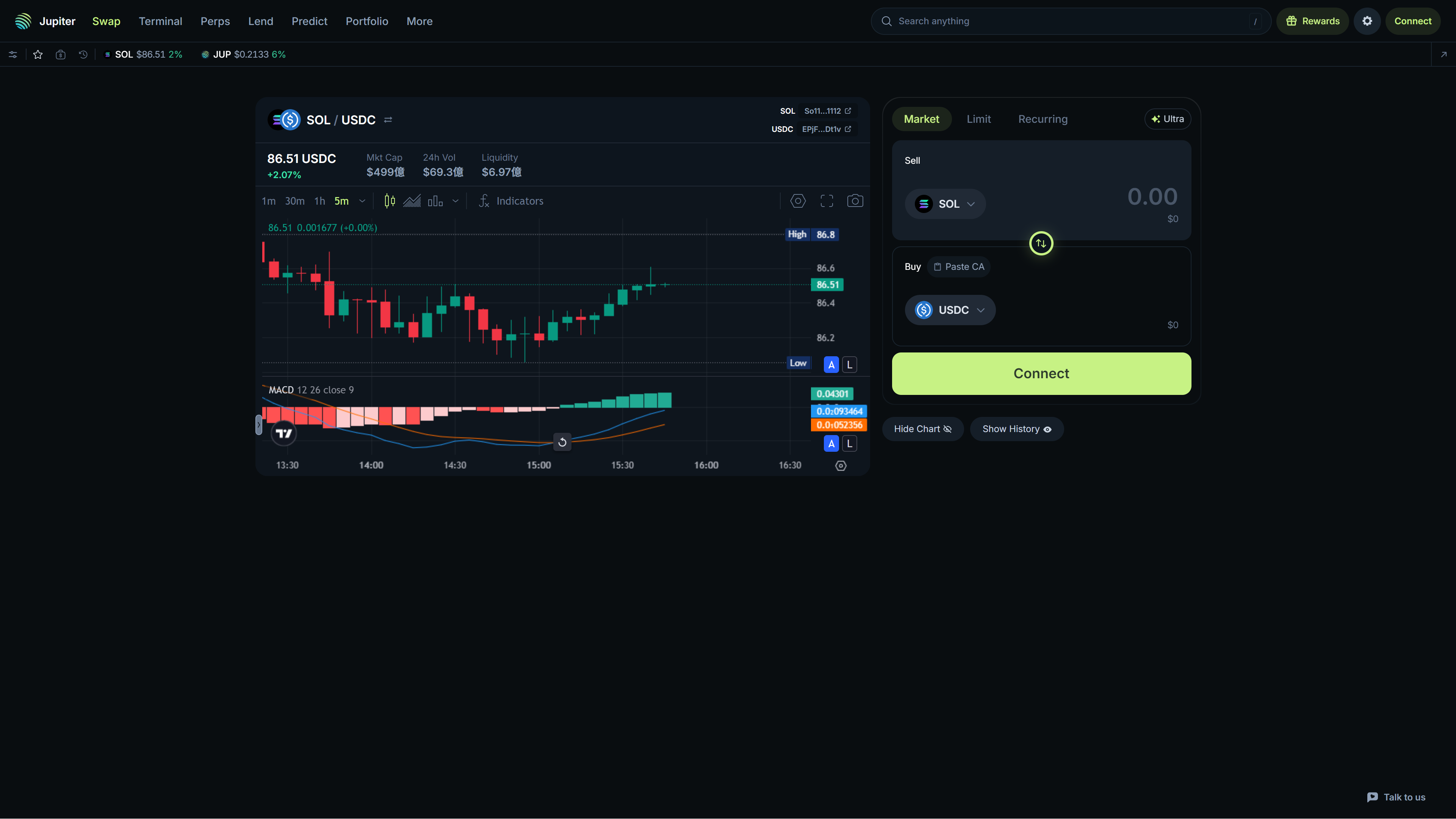
Jupiter is best understood as Solana's broadest swap execution surface. In Market, the main experience centers on Jupiter Ultra with Ultra V3 improvements. Jupiter shows the quote and also works through the route behind it: which routing system can handle the order, how the trade can be split, how much price movement the swap can tolerate, and how the signed transaction should reach the chain. Best Price Routing, Iris, RTSE, and ShadowLane are the names Jupiter uses for different parts of that path from quote to final landing.

Best Price Routing is Jupiter's route search. A router is the system that decides how an order moves through available liquidity, and AMM sources are automated market maker pools that hold tokens for swaps. Depending on the trade and settings, Jupiter can consider routing sources such as Metis, JupiterZ/RFQ, DFlow, and OKX. Metis is Jupiter's on-chain routing engine. JupiterZ/RFQ means request-for-quote liquidity, where market makers can provide a quoted price. DFlow and OKX add more routing coverage. Iris is Jupiter's routing system inside Ultra V3, and its key detail is 0.01% trade splitting: Jupiter can divide a swap into very small pieces when several paths together give the order a better result than one venue handling the full trade. For the user, this can reduce avoidable price impact when Solana liquidity is spread across many pools and routing sources.
Ultra V3 also focuses on what happens after the route is chosen. Jupiter's live settings panel presents ShadowLane as an in-product landing label framed around speed and MEV protection. In plain English, landing is the step where the signed transaction reaches the chain and confirms. MEV protection matters because a visible transaction can be reordered, copied, or priced around before confirmation. RTSE, the Real-Time Slippage Estimator, handles slippage, which is the price movement a user is willing to accept before a swap fails or fills worse than expected. A tight slippage tolerance can make the transaction fail. A loose tolerance can allow a worse fill. RTSE lets Jupiter estimate that tolerance around live market conditions, so the normal Market flow depends less on a fixed number guessed before each trade. Execution risk remains, and the user still needs to review the swap.
Manual mode is the advanced side of Jupiter. It exposes settings that Jupiter Ultra usually handles for the user: max slippage, broadcast fee type, priority fees, Jito, Nozomi, fee type, priority-fee caps, wSOL handling, Direct Route Only, routers, AMM Exclusion, and AMM sources. Max slippage sets the largest price movement the user accepts. Broadcast fee type and fee type describe how the transaction fee is configured. Priority fees, Jito, Nozomi, and priority-fee caps relate to how urgently the transaction is sent and how much the user is willing to pay for that urgency. wSOL handling matters because native SOL and wrapped SOL are distinct assets. Direct Route Only restricts routing to a single liquidity pool. AMM Exclusion lets the user remove specific AMMs from routing. Manual Mode swaps can avoid Jupiter commission; network fees and selected tips still apply. Jupiter's live panel also warns that Manual mode has no refunds, no support, and no incentive eligibility, so the extra control comes with more responsibility.
The screen reinforces Jupiter's trader-first positioning. Market keeps chart data, token data, liquidity, volume, and price movement near the swap form, so the user can read the pair before acting. Limit V2 gives users a trigger-based order path, where the trade waits for a target price or market cap condition. Recurring V2 supports staged execution over time as DCA, or dollar-cost averaging, where the order is divided across repeated intervals. Earlier V1 order paths have been sunset, and current Jupiter order coverage centers on the active V2 flows. Jupiter is dense because it gives users real choices across route quality, slippage, landing, fees, SOL wrapping, routing restrictions, and manual control.
Best for: active Solana traders who want Jupiter's broad routing and Ultra V3 execution help, with Manual mode available when they want direct control over route choice, slippage, fees, and liquidity sources.
2. Raydium
Website: raydium.io/swap
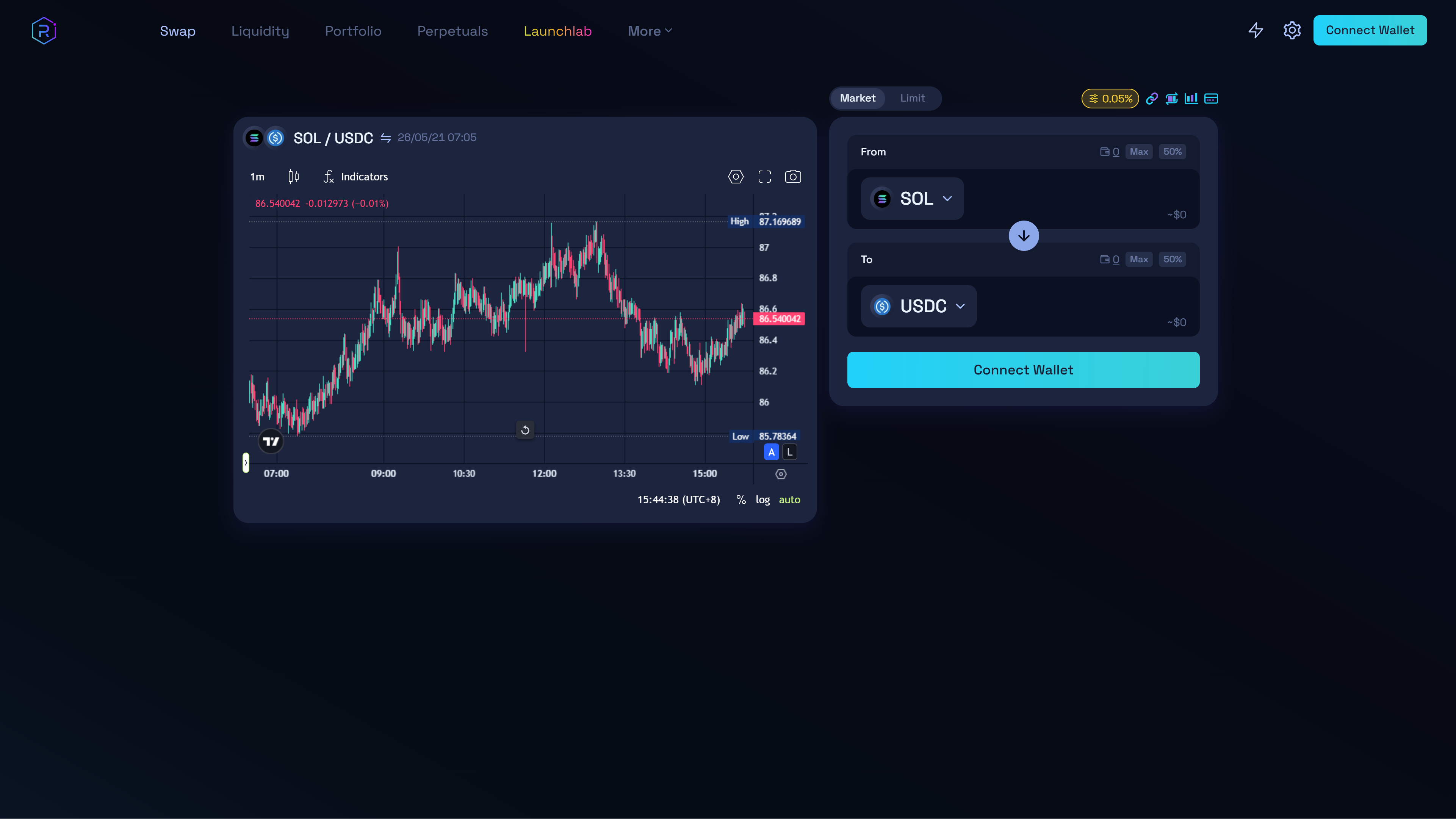
Raydium is strongest when the token's active trading life is already on Raydium. For fresh Solana assets and long-tail pairs, the best swap place is often the venue where the market first became usable. Raydium matters because many of those markets carry visible launch history, an active pool, and a swap route tied to the same venue.

LaunchLab is the clearest example. A token can start inside Raydium's launch flow, trade through early demand, then graduate into a Raydium pool for normal swapping. For a swapper, that means Raydium can be the first place where the token's market becomes readable: the launch history, active trading venue, and available swap path are connected through the same product.
Raydium also works well when the user wants to know whether a token is genuinely trading on Raydium. Its swap flow can show whether the route uses a direct Raydium pool, a multi-hop path, or a split across Raydium liquidity. That matters for newer tokens because the route itself tells the user whether Raydium is actually the market being used.
For established Raydium pairs, the value is direct venue access. The user is swapping inside the place where liquidity providers maintain the market, fees accrue to the pool, and the pair's trading activity is organized. A normal swapper can ignore protocol acronyms. The useful point is simpler: Raydium is good when the token's real trading support is already there.
That makes Raydium a practical choice for Solana tokens with a Raydium-centered market life: launches that graduated there, niche assets that trade actively there, and pairs where the route shows Raydium liquidity doing the work. The strength is proximity to the venue that made the token tradable.
Best for: users swapping Solana tokens whose active market is on Raydium, especially fresh launches, long-tail assets, and pairs where the visible route shows Raydium liquidity carrying the trade.
3. Kamino
Website: kamino.com/swap
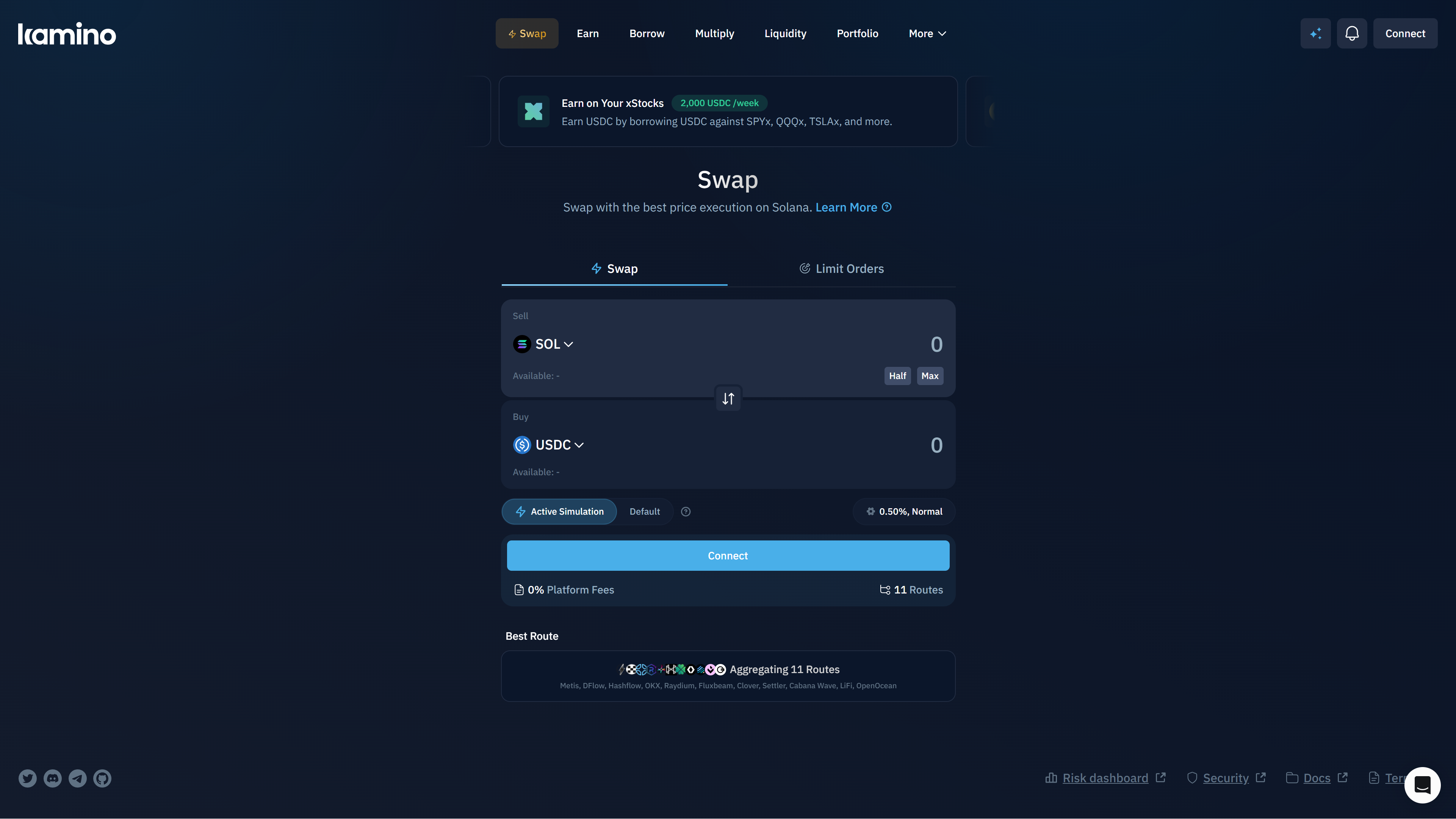
Kamino focuses on the moment when a quote becomes a transaction. A route can look strong at preview, then weaken as liquidity moves, accounts update, or execution conditions change. Kamino handles that risk by evaluating executable paths across 15+ routing engines, selecting the highest-output path among the routes it can evaluate for the pair and size, and running that path through Active Simulation before the user signs.

That routing layer gives the swapper context behind the output number. Route counts, quote comparison, and selected-path details help explain why a route was chosen, especially when trade size affects available liquidity or Solana market conditions move quickly. The swap feels easier to judge because the path behind the quote has already gone through comparison.
Active Simulation gives Kamino its strongest swap-specific identity. The product checks the transaction before presenting the quote, checks again as the quote ages, and verifies again at execution. Price impact, slippage tolerance, and minimum received stay close to the signing decision, with the selected path tested near current chain conditions.
Kamino's broader DeFi suite makes the swap tool especially useful for people already managing capital there. The same routing layer supports Multiply, collateral repayment, and single-asset vault deposits, so swap execution connects naturally with lending, leverage, and portfolio actions. A user adjusting a position or moving collateral can keep the trade inside the same workspace that created the need for the swap.
The result is a swap surface built around checked execution: route comparison, simulation, and DeFi workflow context all sit before the signature. Kamino's lane is confidence before approval, especially when the swap connects to an existing position or portfolio action.
Best for: Solana traders who want Active Simulation, route validation, and a checked quote before signing, especially on size-sensitive or fast-moving swaps.
4. OKX
Website: web3.okx.com/dex-swap
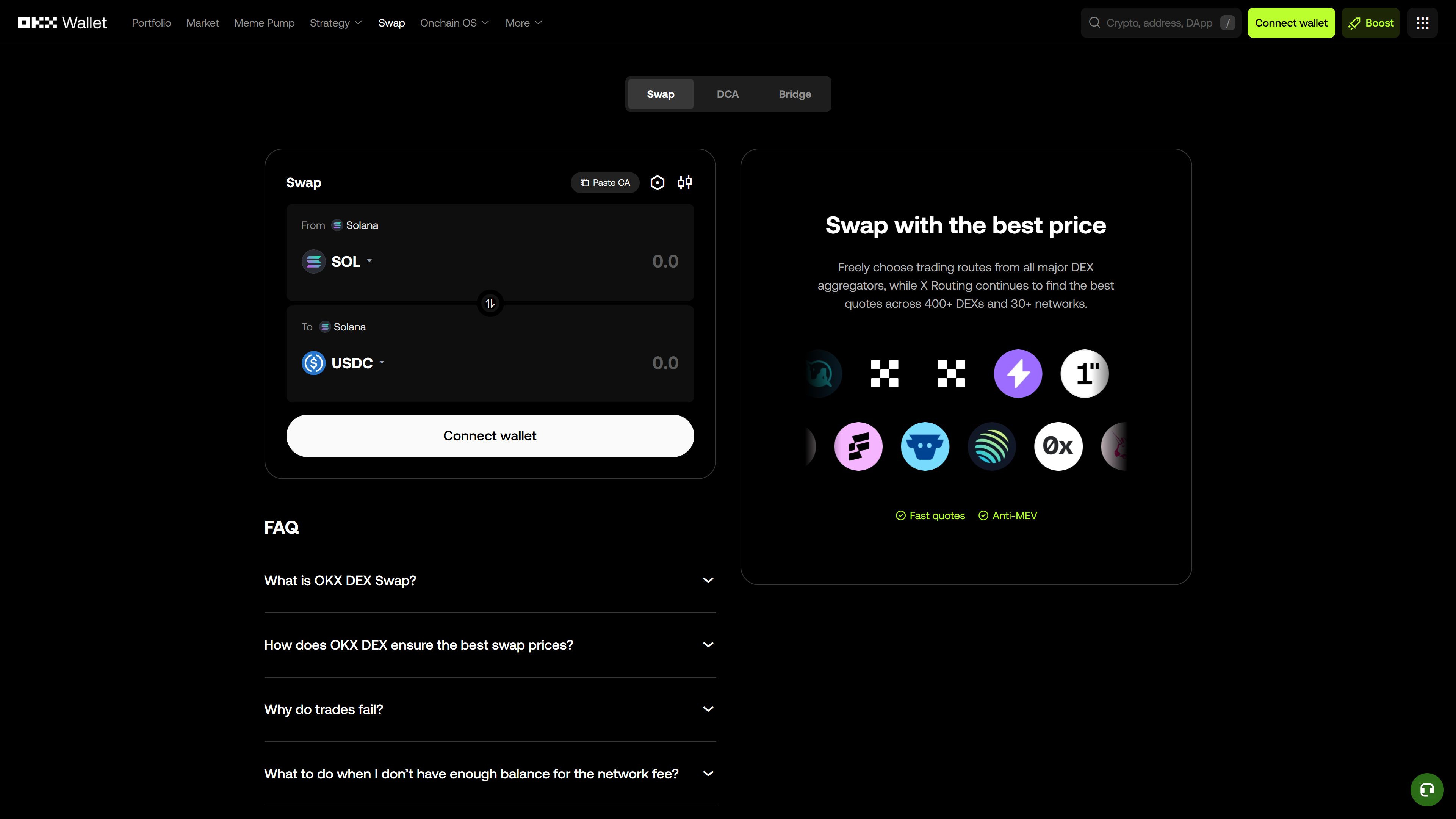
OKX Swap's Solana use case starts with route stress: what happens when the order size begins to matter against available pool depth. X Routing compares liquidity pools, simulates possible paths, and weighs price, slippage, and network fees before the user signs. When one pool gives a weaker fill for the full amount, the router can split the order across pools, so the quote reflects how much liquidity each path can absorb.

That makes OKX most interesting on larger or thinner swaps. The product value is the work behind the receive amount: finding a path that can carry the trade without letting price impact eat too much of the output. A small swap may look ordinary anywhere, but a size-sensitive swap gives X Routing room to prove whether splitting the order improves the final result.
The slippage controls give the signer three different execution postures. Dynamic slippage follows live market and on-chain conditions, Fixed slippage holds the trade to the user's exact tolerance, and Capped slippage lets the adaptive setting move under a hard ceiling. That turns slippage from a single guess into a choice about fill probability, price protection, and how much movement the signer will allow before the swap fails.
Anti-MEV protection is the execution layer worth calling out. Pending swaps can attract front-running and sandwich attempts when the trade is large enough or the token is volatile enough. OKX's protection reduces that exposure where supported, while the user still has to judge the route, expected output, and slippage setting together before approval.
The fee model is the OKX-specific caveat beside the route. OKX publishes DEX interface fee categories of 0%, 0.1%, 0.25%, and 0.5% depending on token-pair group, with exemptions for certain transaction types. A strong OKX quote has to survive that all-in check: expected receive, minimum receive, price impact, interface fee where it applies, and Solana network cost.
Best for: Solana traders making size-sensitive or thin-liquidity swaps who want X Routing to search and split available pool liquidity, with slippage modes and Anti-MEV protection available before signing.
5. Titan
Website: titan.exchange/swap
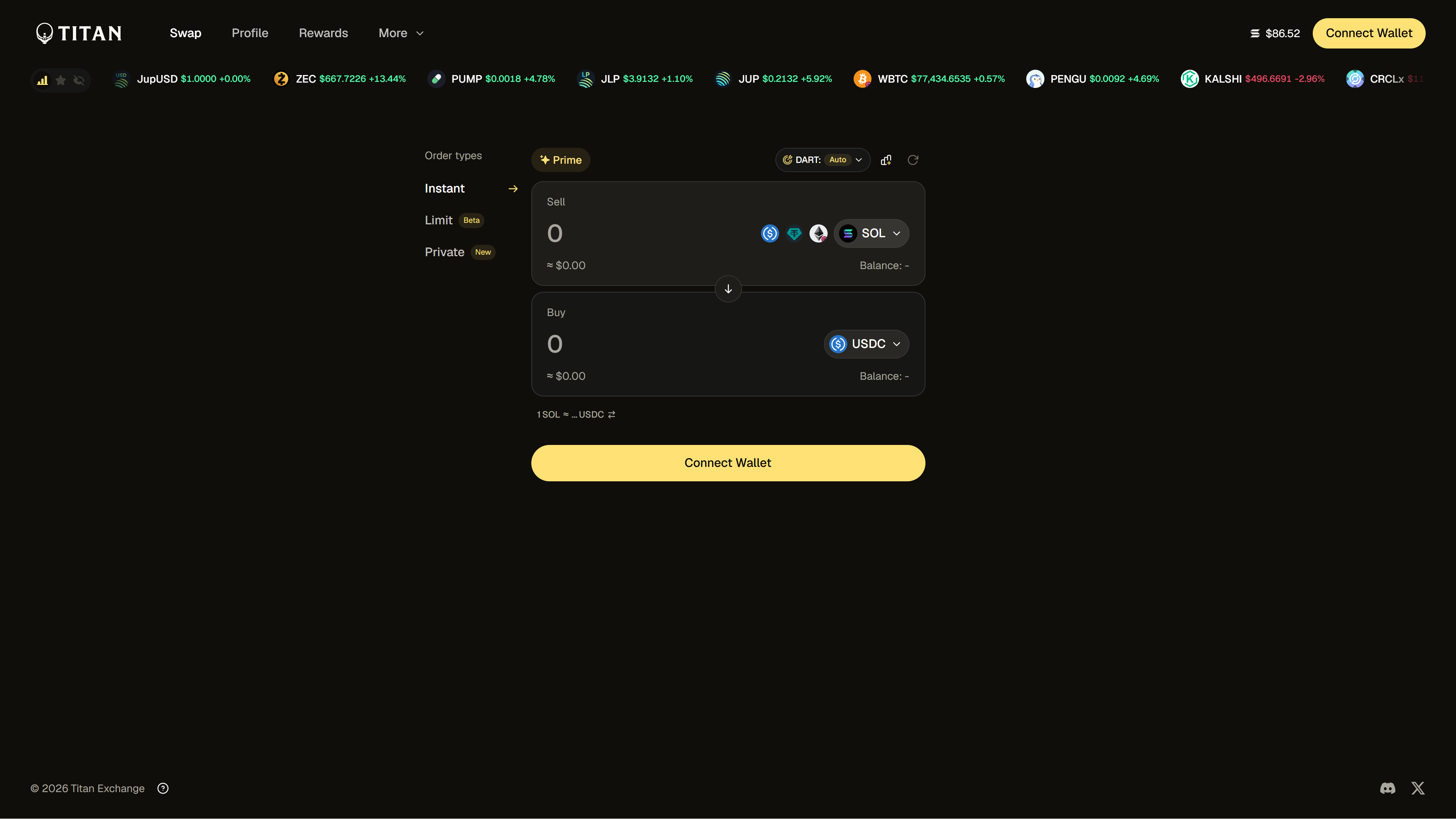
Titan's swap identity is execution posture. The screen starts from Instant, then puts Private New, Prime, and DART: Auto close to the trade form. That layout matters because the user is choosing how fresh the quote should be, how much routing automation should help, and whether the swap should go through the main wallet path or a separate private path.

DART is the routing feature that gives Titan its clearest swap angle. Dynamic Allocation and Real-Time Routing can run in Auto, Only, or Off modes, letting the quote move between Titan's off-chain Argos routing and DART's execution path. In live quote inspection, Titan exposed route sources such as Titan DART, Titan Best Price, Métis Binary, and Pyth Express Relay. That source view makes the output easier to judge because the user can see which engine is carrying the quote before signing.
Instant is the fast market-swap path. Titan keeps quotes fresh, checks multiple aggregator routes, and runs on-chain simulation before showing the estimated output. For Solana swaps, that keeps the review closer to current pool conditions while the user is choosing the amount, checking the received side, and preparing to sign.
Prime is the automation lane. Its job is to reduce the amount of manual execution tuning around a market swap: slippage handling, transaction landing, sandwich protection, and Titan fee handling are bundled into the mode. That makes Prime the part of Titan to consider when the user wants the product to handle more of the route and submission work during a busy market.
Private New gives Titan a separate story from ordinary market routing. The flow uses a Vanish wallet as an intermediary signer, with funds moving between the main wallet and the Vanish wallet before the private swap. The practical effect is wallet-trace separation: the swap is designed so the main wallet history does not directly carry the private trade. The boundary matters too: SOL must be one side of the private swap, while the other side can use supported SPL or Token-2022 assets.
Best for: active Solana traders making fast market swaps, especially when they want DART route checks, Prime automation, or Vanish-backed privacy for trades they do not want tied directly to their main wallet history.
6. Gemorik
Website: gemorik.com/swap
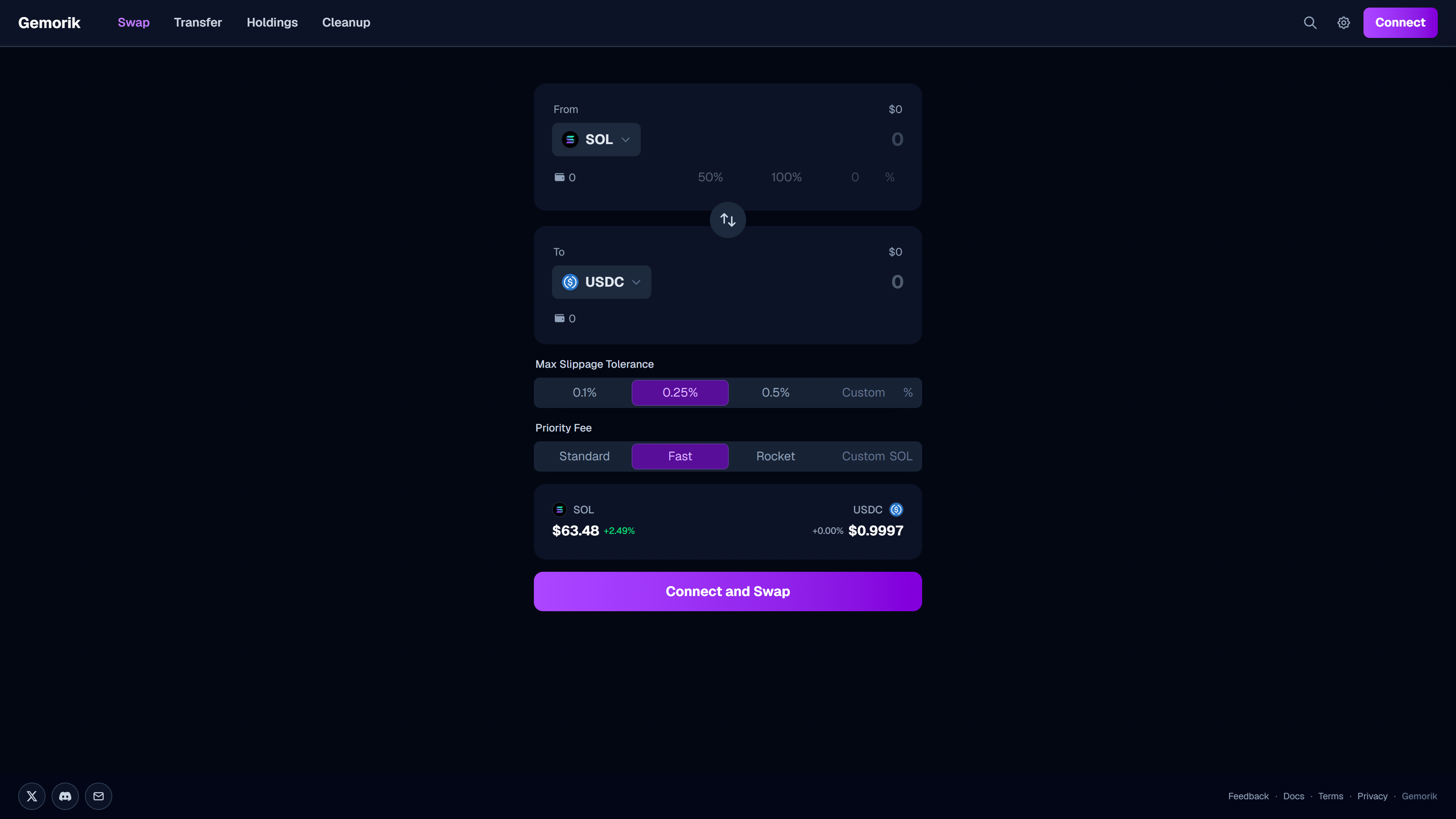
Gemorik's swap flow is built around aggregator-backed routing and clear cost visibility. It brings supported sources such as Jupiter, OKX, and DFlow into one Gemorik swap flow, then prepares the trade from the executable quote selected for that swap. The user can review the selected source, swap settings, slippage choice, priority fee choice, and expected output before signing. Gemorik also runs preflight checks before the swap goes on chain, helping reduce failed transactions before the user commits the trade.

The expense review is where Gemorik becomes especially useful. Before approval, the swap summary can break down what the user is paying for: the swap amount, base chain fee, selected priority fee, and token-account rent when a new account needs to be opened. When rent can be reclaimed later, Gemorik shows that context as part of the cost review, so the user can separate normal network fees from Solana account-state costs.
After execution, Gemorik keeps the same transparency in the result view. The receipt shows the final cost, received amount, actual-versus-expected result, transaction link, and fee breakdown. That gives the user a clear post-swap answer: what was paid, what arrived, and how the final result matched the swap reviewed before signing.
The useful follow-through is what happens after several swaps, when the wallet starts carrying the small leftovers of active trading. WSOL may still be wrapped, empty token accounts may still hold rent, and dust can make a position look unfinished even after the main trade is done. Gemorik keeps native SOL and WSOL separate, then gives the user a cleanup path for eligible WSOL unwraps, empty-account rent recovery, and dust burning. The swap flow stays focused on execution, while the surrounding product helps the user keep the wallet ready for the next trade.
Best for: Solana users who want clear expense review before signing, transaction protection through preflight checks, and a post-swap receipt showing what was paid, what arrived, and which Solana account costs were involved.
Summary table
| Option | Screen promise | Best for | Limitation |
|---|---|---|---|
| Jupiter | Router competition and execution controls | Active traders managing route, slippage, and fees | Advanced controls need careful review |
| Raydium | Pool routing and launch context | Tokens with active venue liquidity | Limited to supported pool routes |
| Kamino | Active Simulation across 15+ routing engines | Swaps needing route comparison and Active Simulation | Live liquidity can change before execution |
| OKX | Size-sensitive route search | Large or thin-liquidity swaps | Pair-based fees may apply |
| Titan | Instant, DART, Prime, and private modes | Fast swaps and private swaps | Private swaps require SOL on one side |
| Gemorik | Expense review and receipt clarity | Cost-aware swap review before and after signing | Token support depends on liquidity and route availability |
Conclusion
A Solana swap starts as a quote, becomes a transaction, and ends as a receipt. A good swap surface keeps those stages connected: it makes the route understandable, shows the costs that affect execution, keeps slippage close to the signing decision, and gives the user a clear place to verify the result after confirmation.
After comparing Jupiter, Raydium, Kamino, OKX, Titan, and Gemorik, the pattern is clear. A simple swap needs a clear route and a transaction the user can approve with confidence. A larger or thinner trade needs stronger evidence around liquidity, fees, and execution. Frequent swapping needs clear costs before signing and proof of what happened after the transaction lands. Use the comparison to find the swap surface that fits your next trade best!
Quick links
Jupiter: jup.ag/swap
Raydium: raydium.io/swap
Kamino: kamino.com/swap
Titan: titan.exchange/swap
Gemorik: gemorik.com/swap